


A New Steam Board
It was an extremely challenging board but it reminded me how much I like Steam. This definitely needs to get to the table more often.
Eclipse Tryout
Twilight Imperium III Day
I’m looking forward to it, while still being a little overwhelmed about the rules.
Still, it will be fun…
A Good Dirk
Many Eurogames that are designed for 3+ players have a two player variant. These are often rather undesirable because they seem tacked on to the rules as an afterthought, usually as a marketing decision to sell more copies.
The two player problem is often solved (poorly) through the addition of a fake third player. This was done most stereotypically in Alhambra, where the fake third player is called “Dirk”, after the designer of the game, Dirk Henn. After encountering the fake third player in that game, we now exclusively refer to that fake third player in a game as Dirk, no matter what the game.
Due to the usually poor integration of Dirk into game rules, I was reluctant to try the two player variant in 7 Wonders, but Rafael persuaded me to try it. The completed game is below with Dirk on the right hand side.
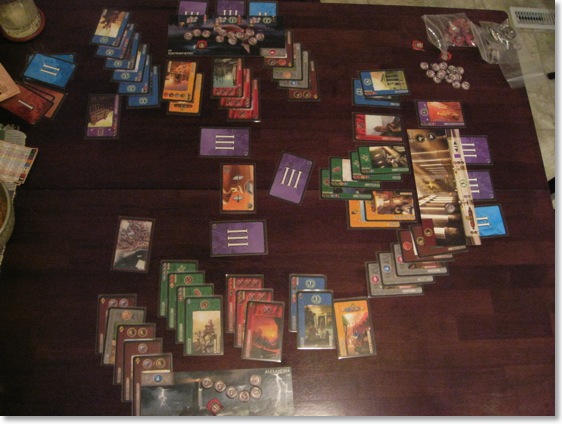
I was surprised at how well the play went with a Dirk player. In the Dirk variant for 7 Wonders, players exchange their hands with each other every turn and the lead player selects one extra card from Dirk’s pile. The lead player then plays one card to his board and another card to Dirk’s board. Next turn the opposite player becomes the lead and repeats the process.
This leads to many interesting variations such as: forcing Dirk to buy resources from you, arranging cheaper resources for yourself, and causing Dirk to pay less to your opponent than yourself. These underhanded techniques may cause your opponent to glare at you when they work in your favour.
We will probably play with Dirk more often, at least in 7 Wonders.
If you have the game I urge you to give it a try.
Caylubration 2011
Since our board game group is playing this week, it seemed a great time to pull out Caylus and give it a try again.
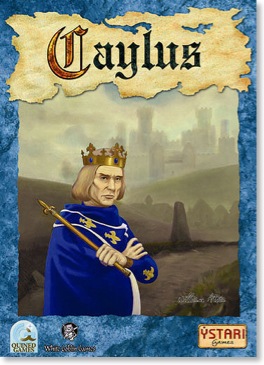
Jeremiah, Craig and Jason all studied up by listening to Sturm’s How to Win at Caylus podcast. Steve any myself didn’t have a chance to listen to it before the game. It seemed to give them an edge because they were in the top three places, with Jeremiah winning Caylus for the first time.
Here’s a picture of the board near the end of the game.
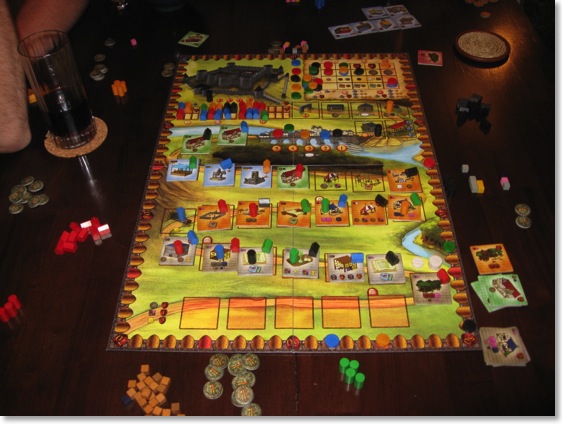
This game was quite different from the others we’ve played. The score was much higher and we had many more prestige buildings out than any of the other times we’ve played. Resources were also very scarce, making each turn tense. The game was a challenge up to the last turn. Even though I didn’t come close to winning I had a great time.
I recommend that you give Caylus a try if you’ve never played it. Caylubration is certainly a great week to give it a go. Caylubration runs from May 16-22, 2011.
Playing Steam
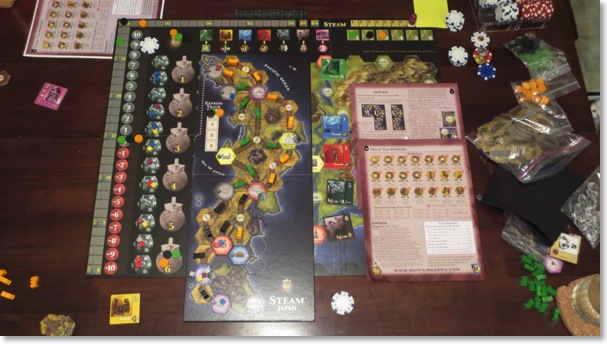
Steam is a pick up and deliver game where you build track between cities or towns. Once you have connected cities together, you claim the track between them as your own. You can see several tracks claimed by the coloured locomotives on the tracks below.
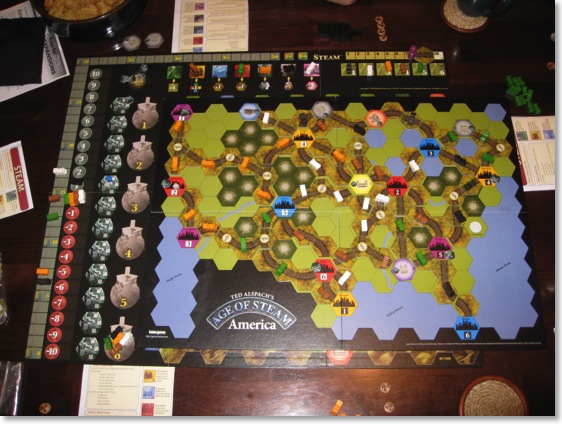
After the tracks are in place, you can deliver the goods that are on the cities to get points or more money to finance your railway.
The board shown here is the America expansion board from Age of Steam. Even though the games have important differences many of the expansion boards work with both games.
I was smack in the middle of the winners, which is a kind way of saying I was in third place. I think that Steam will take several more plays before I can understand the dynamics of the game.
Nevertheless, I enjoyed the game very much and look forward to playing it again.
If you are thinking of buying a train game, this would be a great addition to your collection. I wouldn’t recommend it as the first train game, though, as it can be a bit of a brain burner. You might want to start with Ticket to Ride: Europe or Railways of the World: The Card Game, which are both fine games with many interesting strategies.
A Penny for My Thoughts
There’s also line of storytelling games that dip a toe into the Role Playing Game category. These ones don’t focus on stats and hit points and other accounting measures, but are pretty free form from that perspective. You don’t need a lot of preparation to play them, you can generally sit down and start playing. They also are much shorter, so you can often finish them in a night.
One game I tried recently that I enjoyed is A Penny for My Thoughts, by Paul Tevis. I had Jeremiah and Craig over and we gave it a go.
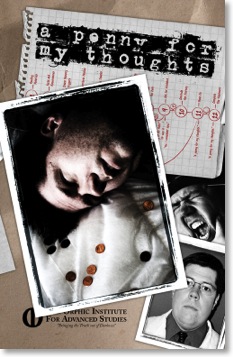
In this game you are all patients at the Orphic Institute for Advanced Studies. You and all the other patients around the table have suffered complete memory loss and are all trying to regain your memories. The institute has given you a dosage of a drug that allows you to see glimpses into the thoughts of the other participants at the table. Together you work towards regaining your memories.
Pennies are important tokens in the game that allow you to negotiate the telling of important parts of the story by passing the pennies from one person to another. The passing of a penny coincides with a moving forward of the story line for that person as your fellow players move your plot along. This allows you to answer three questions on your sheet that describe key parts of who you were before you lost your memory. When all three questions are answered for each player, the game is done.
We played a spy themed game where we were all spies who had lost their memories, which was a nice change from what we usually play and allowed some James Bond-ing to occur.
An important part of improv is the “go with the flow” aspect, where you work off of others ideas. If you say no to such ideas then it halts the flow of the story. In A Penny for My Thoughts, you can’t say no to someone’s suggestion. Instead, you have to say “yes..and” and work with it. Of course, there’s no limit to where you can take it after that, but you have to incorporate the ideas presented by the other players.
It was quite an enjoyable night and I think we would like to try it again with another theme, now that we have the hang of the game.
The game book itself is written very well and has a great medical feel to it to encourage the characters along. Notable in a positive way is the lack of grammar and spelling errors. These are unfortunately often present in indie games today (and mainstream games, for that matter).
I highly recommended it anyone who likes storytelling games with some improv.
A Test of the Imperium
All that good press aside, I’ve been reluctant to purchase it because of it’s very long play time. The box says 3-4 hours but I think that is extremely optimistic. I would say 5-6 would be a better estimate with experienced players. My Friendly Local Game Store Sentry Box recently started a rental programme with their board games. Instead of trying out the game in the store, you can rent the game for a small fee and take it home to play for a week. If you like the game, then you can apply the rental fee to the purchase of the game itself. I think that’s a great programme and it gave me the opportunity to rent TI3 to try it out.
My regular Monday night gaming group set up a special Sunday game day specifically to play TI3. We had to schedule it a couple of months in advance with the various significant others. That day happened today.
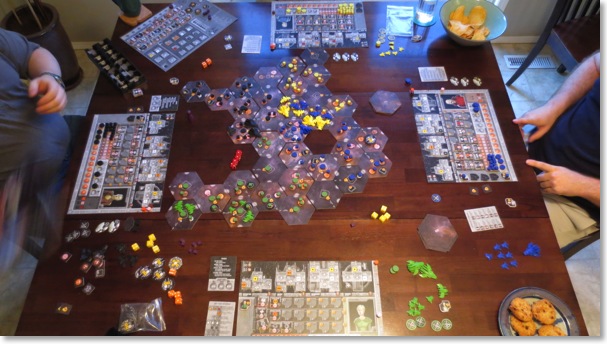
Here’s a picture of the game about halfway through (at the four hour mark). This is a five player game.
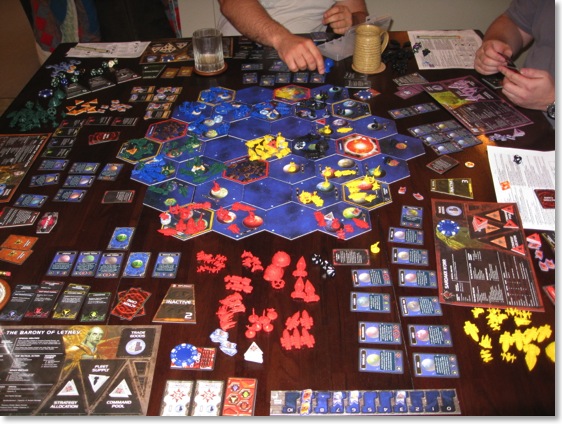
As you can see there’s a lot of bits in this game. The complexity is quite high and there are many things going on at the same time.
I have to say that I did enjoy the game, but I don’t think it’s for me, for a couple of reasons.
First, the game has an extremely long play time. I am used to playing games that take 45min-2 hours. Although I never felt that the game dragged or that there was any downtime, it was still a very long tIme to sit in one place to play a game. Second, the game is a conquest-style game, so naturally encouraged a lot of conflict. I really don’t like that kind of warfare-like conflict in my games and so it really isn’t my type of game. Still, I wanted to give it a try just to see how it feels. There are always exceptions to what I regularly play.
So the final verdict is that it is indeed a good game. It’s very well put together and there are lots of interesting options and things you can do on your turn. The cards modify the game in cool ways and cause you to modify your strategy and really think about your turns to use them carefully.
However, I won’t be buying the game. It’s not a game for me, but I am happy that I played it.
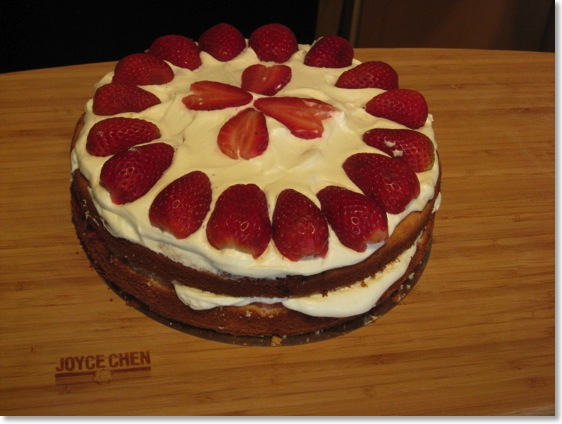
One other notable mention: Craig did bring over a wonderful treat. It was a Strawberry Shortcake using a sponge cake rather than the traditional biscuit cake. It was delicious. Thanks Craig!
Games with Nasty Intent
There are also games that have a bit of bait-and-switch to them. These games look innocuous but by playing them you quickly realize that they aren’t as nice as they appear. These are “wolf in sheep’s clothing” games, to continue the sheep theme, though I don’t know how much farther I can push it. Here I’m thinking of Tongiaki (Uberplay) and Kahuna (Rio Grande)/Kanaloa (Tilsit). Coincidentally, these games all have tropical themes, though I’m not sure if there’s anything in that.
These games use bright pretty colours, and you are lulled into a sense of serenity as if you were sitting on the beach having drinks with little umbrellas in them. That is, until you are rudely awakened from this illusion when your opponent cackles nastily and sinks your boats (Tongiaki) or blows your bridges off the island (Kahuna/Kanaloa), and does it with a smile. You soon realize that the bright pretty colours were hiding a game where you now have to fight for your life and the little umbrellas won’t save you.
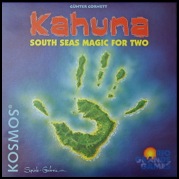
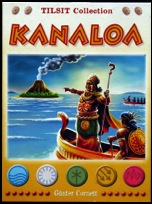
I recently discovered that there is a third category of games that fit with this theme of nastiness (screwing up your opponent’s plans in a nasty fashion). These are games you have played for a while and know them to be “nice” games; known for their competition, surely, but not games that encourage nastiness. These games have well, I suppose you could say “chivalry” to them, or perhaps “gentlemanly competition”, where the competition is definitely present, but the gloves stay on. (I couldn’t think of how to fit sheep into this one, which is probably for the best.) Imagine a proper English tea on a sunny Sunday afternoon with a game of dominoes or backgammon. That kind of thing.
Well, I was rudely awakened recently when one of the games I had considered “chivalric” had suddenly revealed itself to have a nasty underbelly.
Carcassonne: The City by Rio Grande is a stand alone Carcassonne game. It doesn’t have any of the seemingly dozens of expansions from the base game. I believe it to be superior to the base Carcassonne game because of the walls; they close in the game, set a definitive time limit and add tension to the game. I have always though it to be chivalric.
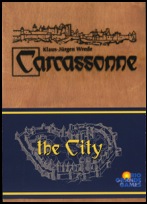
Recently I’ve been regularly playing it with a group of friends over my lunch hour. Surely I can blame them, for they uncovered the nastiness in the game and took it to a level I never expected. I had nothing to do with this and was dragged along as an innocent. You do believe me, don’t you, Dear Reader? I am in earnest here!
Ahem.
At any rate, a recent game was so nasty that I took a couple of pictures of it. The first one below, you will notice the walls have almost entirely closed off the game. This occurs near the end of the game. Once the walls completely enclose the game, or you run out of tiles to place, the game is over.
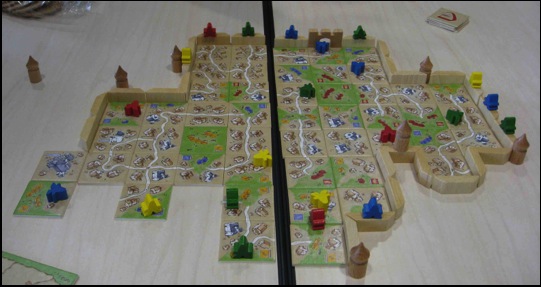
Players experienced with Carcassonne: The City will notice it very unusual that the number of tiles on the table is so small. In fact, a little less than half of them are left. The four players in this game have done a very good job of closing off many scoring avenues. This is usually done with walls.
But yet, there’s more nastiness to come. In the game the wooden playing pieces, called “meeples”, can be oriented in different ways. The ones lying down in the picture are called stewards, and gain you points at the end of the game for every green space that they are connected to. These connections only extend to a green space, a road, or the walls. So, you can stop an opponent from getting more points if you can enclose their steward in a smaller area. What are the smallest possible areas? Well, two of them manifested themselves in this game.
The first is in the picture below. This was such a nasty move that I took a picture of it as it was happening. Here the player (not me) is enclosing the blue steward entirely with green space, meaning blue will only get a pittance at the end of the game. This move was done, of course, with a smile.
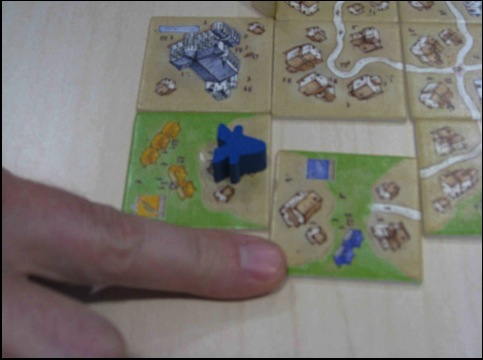
Later on one of my stewards was cut off from all green space using walls, earning me zero points!
All this goes to show that any chivalric game can be surprisingly drawn down into the muck with a combination of players with nasty intent. I had nothing to do with this and was dragged along as an innocent. You do believe me, don’t you, Dear Reader?
All Trains Stop at Kingsport
The Kingsport expansion brings the town of Kingsport into the game, which is a coastal town a short train ride from Arkham. It’s a rather sedentary place, but all nature of unsavoury things can still happen there. The expansion adds some nice effects to the game. There are the moving rifts, which are tears in the fabric of the universe. You don’t want them around because if they stay around for too long Bad Things Happen. There’s a nice assortment of new monsters to fight, though I for one would rather not like to run into a Leng Spider on my Saturday stroll through the park.
The Kingsport Head is also in the game, including the dreaded Strange High House in the Mist. I also like the new Epic Battle cards, which changes the manner in which way the final battle takes place. It’s a nice change and can easily fit in with the rest of the game, even if you don’t use the Kingsport expansion. I quite liked some of the new characters as well.
The more I play Arkham Horror the more I appreciate that it really is a form of RPG with a board. The game is extremely thematic and you don’t necessarily care too much if your hat is handed to you at the end, albeit rather rumpled and torn. The experience is all worth it.
First Impressions of Mythic
It's an intriguing idea. The author, tired of not having people to play RPGs, or not having time to come up with scenarios, set about to create a gaming system that would allow on the fly gaming for Role Playing Games. This may be used with any game system so you can play D&D or Call of Cthulhu or even Illuminati, for that matter. The only thing that limits you is your imagination for spinning storylines.
I must admit that I was (and still am) a little dubious. I find it hard to believe that such a system would actually work very well. I was quite surprised at the number of positive reviews. Though, as we all know, all reviews need to be taken with a grain of salt.
That being said, the approach reminds me a bit of the Once Upon A Time card game, where players take their story in a variety of directions based on what kind of cards they have. It's a very enjoyable game, so why wouldn't something like this work just as well? In both cases you make heavy use of Lateral Thinking and can probably come up with surprising results. I know that you can for Once Upon a Time, at least.
So, I have picked up the PDFs and am going through the rules. So far it looks interesting enough to try. I'll have to do another post later to report my findings.
Mythic looks like it will be an extremely creative exercise. My hope is that it will be fun too.
Tactics Revisited
I knew that statement would garner comment, and so it has. Jeremiah has provided many examples of games where he feels that eurogames do indeed have tactics, but concedes that the range of options at any one time are rather limited (which he points out is not necessarily a bad thing).
Yes, it is true that eurogames have tactics. However, perhaps I didn't explain enough of my rationale about eurogames.
I suppose what I was struggling to describe is related to the two terms "tactics" and "strategy" and how badly they are defined. Someone can point at a strategy and say "see that's a strategy" and point at a tactic and say "see that's a tactic". However, defining them in anything other than example becomes problematic.
The problem is that the terms are interrelated with each other. Perhaps they aren't actually different at all, just terms applied to different levels of abstraction of the same thing. Presume we are talking about board games (see, the examples again!). I have a goal for how I want to move all my pieces from here to there and it will take many moves to do it. That's strategy. Now, I have these immediate problems during my turn, or over the next couple of turns, and I need to figure out how to solve those immediate problems to eventually achieve that goal I was just talking about. That's tactics. But are they different from one another?
I'm arguing that they're not really different. Yes, they are different levels of abstraction and change differently as the game moves forward, but other than the abstraction (or perhaps I could say "level of focus", which is really just another term for abstraction) they are pretty much the same.
What I'm writing makes me think of the the work done by the Goal Oriented Action Planning (GOAP) working group from the IGDA. GOAP is basically a way of programming artificial intelligence into games and other programs. GOAP considers that AIs have a modularity to them and the working group introduces definitions for "goal", "action", and "plan", which they themselves adapt from a planning standard. When you read these terms, they seem very close to each other and to the terms strategy (GOAP goal) and tactics (GOAP plan).
So what does this all mean when I said that eurogames don't focus too much on tactics? Well, it all comes down to feel or perception. Let's assume (as I do) that strategy and tactics are different levels of abstraction of the same thing. What I'm concerned with then is whether the game feels more strategic (more decisions at higher abstraction) or more tactical (more decisions at lower abstraction). Whichever way the game feels then dictates which of these two labels to apply.
In my mind eurogames are structured around making more (not all) decisions at the higher levels of abstraction. Wizard Kings, on the other hand, focuses on more (not all) decisions at lower levels of abstraction. Of course, the degree to which this is done varies from one game to the next, but I believe eurogames feel more strategic.
To use some example provided by Jeremiah: I would apply the strategic label to Caylus, Tigris & Euphrates, Tikal, Java, and Carcassonne: The City. I would argue that Blue Moon City, Samurai and Through the Desert are somewhere in the middle, and that Tongiaki, Kingdoms, Lost Cities, and Blue Moon are more tactical.
I have often wondered if this balance of game play towards the strategic is one of the characteristics defining a eurogame as opposed to an American-style board game, but that is an entirely different discussion.
I doubt this settles the matter. I'm not sure such a matter can ever be truly settled, due to the nature of the words we are using. However, it may help frame the discussion a bit more.
Wizard Kings Tactics
I suppose I should define those terms, since they are easily confused. Tactics refers to the actual steps you take to achieve a goal, whereas strategy defines the overall goal. Wikipedia does a much better job explaining it.
I am exploring this tactical aspect of games though Yggrda Union, but I was really looking for a tactical board game, since I play lots of board games (and have talked about this at length on my website).
Eurogames? err...not so strong on the tactical side. It doesn't seem that eurogames really focus too much on tactics as an essence of game play. (Don't shoot me for generalizing with that statement. Eurogames certainly do have tactics in them.) I looked through my whole collection and could find bits and pieces here and there, but no real game that could fulfil this desire for a truly tactical game.
The obvious place I can go to get these kinds of games are wargames. Many of them are very tactical and very good at it. I looked at Hammer of the Scots and Fire in the Sky. There were many good candidates...but I hesitated. I really don't like the idea of playing wargames. It's one of those slippery slope arguments, but the idea of playing a game where humans are destroying one another through war is really unappealing to me. The slippery slope comes in because all games have some form of conflict, even cooperative games like the excellent Lord of the Rings. I can handle conflict in a fantasy-themed game but I really dislike when it looks too much like war. I even refuse to play the eurogame Memoir 44. I have looked at it and it appears to be a great game and, even though everyone from Tom Vasal on down thinks it's not-to-be-missed, I resist a stylized game of war.
I was able to come up with a compromise I can live with (and also enjoy, let's not forget that!). It comes in the form of the game Wizard Kings from Columbia Games, the famous wargame company in the States. They do a very good job of keeping the rules short and sweet (though at times confusing for mere eurogamers like me). The Wizard Kings maps are of excellent quality and are some of the clearest I have ever seen. I mention this because I have seen some dreadfully confusing maps in other games.
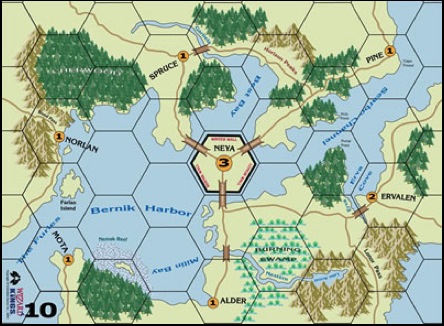
Unlike many wargames, which can play for hours or days, Wizard Kings can play very quickly, with many scenarios taking less than an hour. You can configure the maps in many different configurations, use different armies, and invent whatever scenario you can think of. I particularly like one of the supplied scenarios where the Amazons are defending their great wall from an invasion by the Barbarian horde.
Is it tactical? Yes, very much so. Especially the shorter scenarios, where you have to move very fast in a short number of turns. These scenarios play out in about twenty minutes and have a wonderfully tactical feel to them. Jeremiah and I have played a longer scenario and it was ok, but it felt more like a wargame and lost a bit of the tactical feel I was looking for. We'll probably stick to the shorter scenarios or invent our own.
Now I just have to get better at it. Tactics, that is. I realize that I have a long way to go.
Fire, Ice and Sand
Take Runebound, for example. No matter what we do, the forests are always on fire at some point of the game. There are a lot of forests in the land, let me tell you, and we are reminded of that every time this card appears.
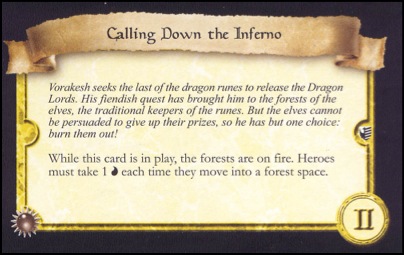
In Arkham Horror, there are equally charming conditions, but at the other end of the temperature spectrum. It would take a pretty cold day to slow down those beasties. Naturally, Arkham is eager to oblige, in spades.
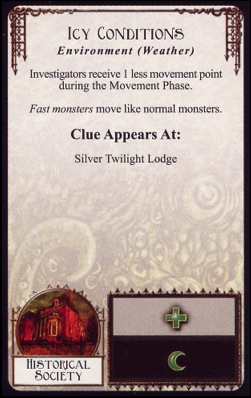
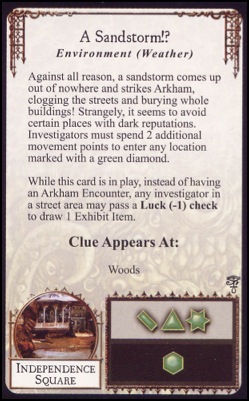
The Egyptian expansion added the wonderful sandstorm to Arkham, Massachusetts, and so the "Against all reason..." on the card took on a whole new meaning when one game went from ice to sand in two turns.
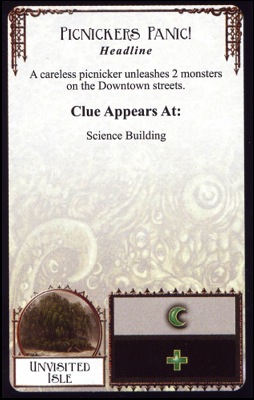
And, of course, we can't forget those careless picnickers.
Reiner softens you up for the big boys
We came very close to victory at two hours but the forces of Azathoth rallied and blew open a whole bunch of astral gates to slow us down. Neither was it very fun having a gaggle of maniacs rampaging through the streets of Arkham, having recently broken out of the asylum en masse after chanting in unison something in an unknown ancient language (probably Egyptian, sometimes I hate that expansion). For once, the cultists were of very little concern, which was a novelty. They were like pups in comparison to what else filled the streets. The wizards were fighting the bad fight and causing no end of trouble in Dunwich, where the Dunwich Horror was slumbering and (gratefully) didn't wake up. We sent the Colour Out of Space to the outskirts so many times it was oozing green out there. Naturally, the picnickers were at it again, causing their own carnage. In short, Arkham came perilously close to being wiped out of existence.
Due to all this, the three hours of game play flew by. We were way too busy sending beasties back from whence they came to notice the time. Nevertheless, I believe that I have found the culprit for my expanded tolerance for longer games. His name is Reiner Knizia and he is very, very guilty. The byline on his website is "Bringing Enjoyment to the People", but it should be really something more sinister like "Bringing Board Game Addiction to the People".
Yes, it's all his fault. He designed a fantastic Lord of the Rings game and then Fantasy Flight Games sold it in North America. Fantasy Flight produces great quality games and they really draw you in. Once I played my first two and a half hour LOTR game, I was hooked. It was a very easy step to other monster length games (forgive the pun) like Runebound and Arkham Horror, and Fantasy Flight makes it oh so easy to get your fix.
I know that the wargame community will scoff at me and tell me that my three hour games are just a quick appetizer for them, but everything is relative. It seems long to me. Except when I'm playing, of course.
I'm just glad that Fantasy Flight takes a long time to release new big box games, otherwise I'll have to significantly revise my maximum playing time guidelines.
Now let me go take care of that Gug before things get out of hand.
BoardGameGeek Sidebar
Now you can see which games I've been playing! Incidentally, you can also see my entire collection of games.
Definitely a Gamer's Game
I guess the actual review will have to wait until I can get the guys together to play it.
Runebound the Boardgame
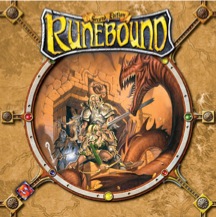
This is one of those big box games from Fantasy Flight, who are known for epic scale games, especially if there are lots of expansions. I say this with humour, because usually their expansions are very good additions to the main game (whereas some expansions from other game companies would have been best left unprinted).
At any rate, I'd best describe Runebound as Dungeons & Dragons without someone playing dungeon master and without scenarios. Oh yeah, it's a lot shorter too. I did play some D&D when I was younger (which lead someone to give my mother an article about how I would be forever damned, which Mom found quite amusing, but I digress). However, playing D&D was always a hassle because it was impossible to get the right combination of people together. Now, today the big factor is time. I have no time to plan these things, nor would I want to spend the length of time required to play even if I did have the time and inclination to worry about scenarios. I do have other things to do, after all.
Enter Runebound. This game has all the wonderful feel of D&D, but in boardgame form. It still was really long (about 4 hours), but Jeremiah and I have found a few combinations of house rules and some of the optional rules to get it down to about 2 hours with two people. These two hours fly by, and so I consider this a successful formula.
The game itself consists of the board, which is a map of the territory, dice for terrain movement and a couple for combat, item cards, hero cards, and encounter cards. Encounters are divided up into a variety of forms and colour coded for difficulty. As you defeat beasties, you gain experience points which allows you to make your heroes stronger in a few different categories of skills. That's generally it. The story line deals with the High Lord Margath who is attempting to take over the world, and you have to defeat him and the Dragon Lords who have sworn allegiance to him. All very heady swords and sorcery stuff, but done quite well. Each of the encounter cards adds a little bit to the story, and it all works very well together. There are a variety of expansions that extend the game in various ways, all expanding the story but still working well together (for some reason every game we are unlucky in that the forests are on fire). There are also major variants, that change the map and the scenarios, for example introducing sailing and island travel, which are a lot of fun too.
If you're looking for deep strategy, you're going to have to play something like Gipf or Tigris & Euphrates. Runebound is an entirely different kind of game, but still one that is a lot of fun. Now, with our shorter game rules, the game is tighter and tenser, and you have to worry every move about what to do; no footling or lollygagging about! To paraphrase Reiner Knizia, a good game is like life; something where you have too many appealing decisions to make each turn and must choose carefully amongst them if you want to do well.
This is definitely a game that I will enjoy playing for quite a while.
You can also check out what Jeremiah thinks.
Til the End of Time is Taking Forever
I spend most of my game playing time playing board games or card games. To me, the fun in game playing is the social aspect of playing with people. I do play some computer console games, however. When I was younger, many of the games I played on my Commodore 64 were dexterity games, like Jumpman and Wizard. They were fun at the time.
Now, I don't have the reflexes or inclination to play such games, and am more interested in thinking about what to do rather than mashing away at the X button. Thus, most of my recent console games are Role Playing Games, or RPGs. These games take quite a bit of time (but not so much button mashing), on the order of 40-60 hours, so understandably not many of them get played in any one year. I do have a real life after all.
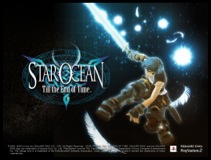
I've recently gone back to a game I put aside about a year ago, called Star Ocean: Til the End of Time. I was stuck and got tired of it. Star Ocean TTEOT is a monster of an RPG on two PS2 discs (and that's not just video on those two discs) with an epic-scope soundtrack covering 5 CDs worth of music! I didn't know what I was getting into when I started it, but now, 40-some hours into the game, I realize that I'm probably not even halfway through! Ack!
This length is a distinction of the games made by triAce. Their first two Star Ocean games, made for the Enix empire, were also punishingly long, though I only learned this recently. So, you have to have a certain amount of almost pathological tenacity to play these games.
The problem is that the game has great characters and a compelling storyline, so it's not that easy to abandon.
So now what do I do? Do I soldier on knowing what is in front of me or walk away from my 40 hour investment? It's certainly no Zork.
Well, for now I'll turn off the game. and go make some tea.
PÜNCT is out!
Pünct is the final game in the fantastic Gipf Project. This project is a series (actually, six) of abstract strategy games, all independent, yet interrelated. Abstract strategy games sometimes have the reputation of being dry, boring, hard to learn, geeky (think chess). The Gipf games are none of these.
NB: Edward de Bono dislikes chess because he feels that it is complex for complexity's sake (see my previous posting). I tend to agree.
These games are all very easy to learn, can be played with pretty much anyone, and can be played at many different levels. You realize the depths of the game only with replay, though you don't need to know them to have fun.
Each of the games in the series have a unique play mechanic that makes the game stand out, even from other similar games. In my mind the most unique is Tamsk , where you need to manipulate time as part of the gameplay.
Perhaps the most interesting twist in the Gipf Project is the use of potentials, where special pieces may be used with Gipf (the flagship game of the series, and my favourite) that tie in with the other games. All the pieces are very simple and do only one thing. They may be added in pretty much any combination, and yet dramatically change the game. It's a pity that more people don't play with the potentials, because they really are a stroke of genius.
If anything could be called a magnum opus in the gaming world for achievement by a game designer, this would be it for Kris Burm.
My copy of Pünct is already on order to complete my Gipf Project collection. I have no doubt it will be played often.