


A Penny for My Thoughts
There’s also line of storytelling games that dip a toe into the Role Playing Game category. These ones don’t focus on stats and hit points and other accounting measures, but are pretty free form from that perspective. You don’t need a lot of preparation to play them, you can generally sit down and start playing. They also are much shorter, so you can often finish them in a night.
One game I tried recently that I enjoyed is A Penny for My Thoughts, by Paul Tevis. I had Jeremiah and Craig over and we gave it a go.
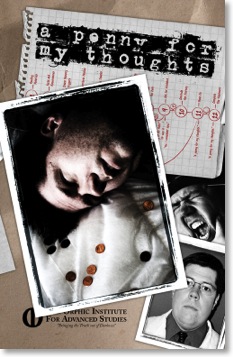
In this game you are all patients at the Orphic Institute for Advanced Studies. You and all the other patients around the table have suffered complete memory loss and are all trying to regain your memories. The institute has given you a dosage of a drug that allows you to see glimpses into the thoughts of the other participants at the table. Together you work towards regaining your memories.
Pennies are important tokens in the game that allow you to negotiate the telling of important parts of the story by passing the pennies from one person to another. The passing of a penny coincides with a moving forward of the story line for that person as your fellow players move your plot along. This allows you to answer three questions on your sheet that describe key parts of who you were before you lost your memory. When all three questions are answered for each player, the game is done.
We played a spy themed game where we were all spies who had lost their memories, which was a nice change from what we usually play and allowed some James Bond-ing to occur.
An important part of improv is the “go with the flow” aspect, where you work off of others ideas. If you say no to such ideas then it halts the flow of the story. In A Penny for My Thoughts, you can’t say no to someone’s suggestion. Instead, you have to say “yes..and” and work with it. Of course, there’s no limit to where you can take it after that, but you have to incorporate the ideas presented by the other players.
It was quite an enjoyable night and I think we would like to try it again with another theme, now that we have the hang of the game.
The game book itself is written very well and has a great medical feel to it to encourage the characters along. Notable in a positive way is the lack of grammar and spelling errors. These are unfortunately often present in indie games today (and mainstream games, for that matter).
I highly recommended it anyone who likes storytelling games with some improv.