A Good Dirk
Many Eurogames that are
designed for 3+ players have a two player variant.
These are often rather undesirable because they seem
tacked on to the rules as an afterthought, usually as a
marketing decision to sell more copies.
The two player problem is often solved (poorly) through
the addition of a fake third player. This was done most
stereotypically in Alhambra, where the fake third
player is called “Dirk”, after the designer
of the game, Dirk Henn. After encountering the fake
third player in that game, we now exclusively refer to
that fake third player in a game as Dirk, no matter
what the game.
Due to the usually poor integration of Dirk into game
rules, I was reluctant to try the two player variant in
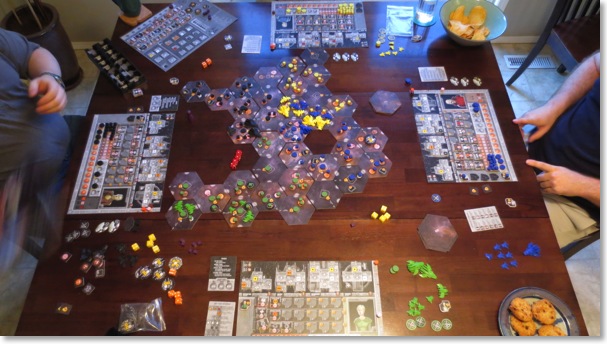
7 Wonders, but Rafael persuaded me to try it. The
completed game is below with Dirk on the right hand
side.
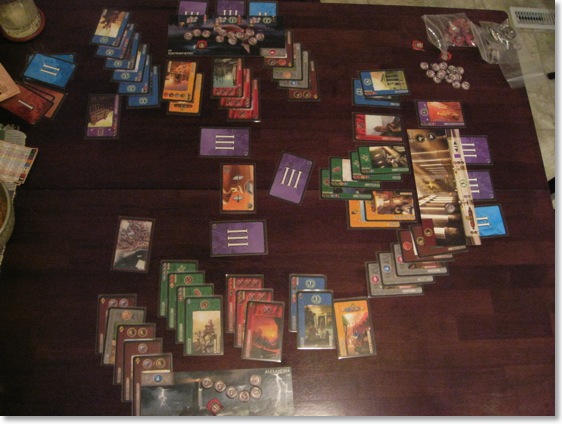
I was surprised at how well
the play went with a Dirk player. In the Dirk variant
for 7 Wonders, players exchange their hands with each
other every turn and the lead player selects one extra
card from Dirk’s pile. The lead player then plays
one card to his board and another card to Dirk’s
board. Next turn the opposite player becomes the lead
and repeats the process.
This leads to many interesting variations such as:
forcing Dirk to buy resources from you, arranging
cheaper resources for yourself, and causing Dirk to pay
less to your opponent than yourself. These underhanded
techniques may cause your opponent to glare at you when
they work in your favour.
We will probably play with Dirk more often, at least in
7 Wonders.
If you have the game I urge you to give it a try.
Caylubration 2011
Since our board game group is playing this week, it seemed a great time to pull out Caylus and give it a try again.
Jeremiah, Craig and Jason
all studied up by listening to Sturm’s How to Win at Caylus podcast. Steve
any myself didn’t have a chance to listen to
it before the game. It seemed to give them an edge
because they were in the top three places, with
Jeremiah winning Caylus for the first time.
Here’s a picture of the board near the end of the
game.
This game was quite
different from the others we’ve played. The score
was much higher and we had many more prestige buildings
out than any of the other times we’ve played.
Resources were also very scarce, making each turn
tense. The game was a challenge up to the last turn.
Even though I didn’t come close to winning I had
a great time.
I recommend that you give Caylus a try if you’ve
never played it. Caylubration is certainly a great week
to give it a go. Caylubration runs from May 16-22,
2011.
A Tasty Morsel
In fact there are so many apocryphal stories surrounding sandwiches that you wonder how much about what we know about sandwiches is true.
That said, there’s quite a lot to learn, as I found out while reading Sandwich: A Global History by Bee Wilson.
This slim volume is part of
The Edible Series by Reaktion Books. If it’s any
indication of the others, the series is fine indeed.
Wilson begins with the Fourth Earl of Sandwich and
proceeds to take us through a trip around the world
discussing the forms of sandwiches and their ethnic
origins.
Sandwiches have at different times been eaten by the
poorer classes, the nobility, workers, picnickers,
hikers and everyone else who is on the go. The ability
to eat a sandwich in one hand (as opposed to a sit-down
dinner with cutlery) allows us to do things with the
other hand like take notes, write reports, read and
more recently type on the keyboard. This says just as
much about the changes in our lives related to eating
and dining habits as it does about the sandwich itself.
She also covers other interesting tidbits like,
according to a court ruling, a burrito is not a
sandwich. You’ll have to read the book to find
out why.
The book has many other interesting tidbits related to
this seemingly simple meal.
The final section lists many different sandwiches,
their ingredients and where they were invented, if
known. I quite enjoyed learning about the incredible
variety of treats wedged between a two slices of bread.
I recommend giving this tasty volume a read.
Sandwich: A Global History
Bee Wilson
2010, Reaktion Books Ltd.
ISBN 978-1-86189-771-8
Playing Steam
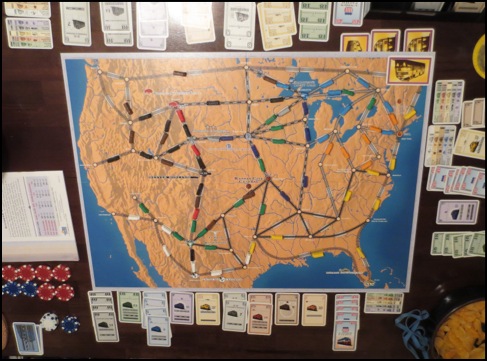
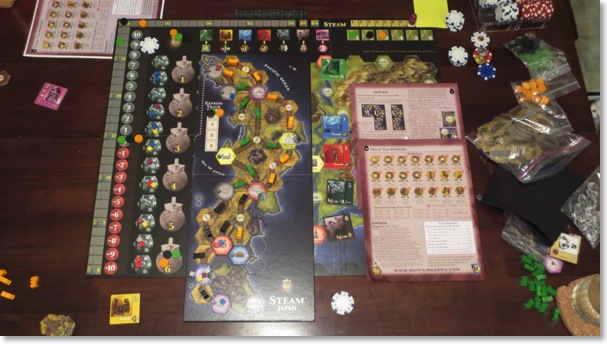
Steam is a pick up and deliver game where you build track between cities or towns. Once you have connected cities together, you claim the track between them as your own. You can see several tracks claimed by the coloured locomotives on the tracks below.
After the tracks are in
place, you can deliver the goods that are on the cities
to get points or more money to finance your railway.
The board shown here is the America expansion board from Age of
Steam. Even though the games have important
differences many of the expansion boards work with
both games.
I was smack in the middle of the winners, which is a
kind way of saying I was in third place. I think that
Steam will take several more plays before I can
understand the dynamics of the game.
Nevertheless, I enjoyed the game very much and look
forward to playing it again.
If you are thinking of buying a train game, this would
be a great addition to your collection. I
wouldn’t recommend it as the first train game,
though, as it can be a bit of a brain burner. You might
want to start with Ticket to Ride: Europe or Railways of the World: The Card Game,
which are both fine games with many interesting
strategies.